C.4. Measure Temporal Dimensions of Behavior: Duration, Latency, and Interresponse Time
Overview:
Understanding and measuring the temporal dimensions of behavior are essential for BCBAs as these measurements provide insight into the length, initiation, and timing of behaviors. Each dimension serves a specific purpose in analyzing behaviors, and selecting the appropriate measure is crucial for effective behavior intervention planning.
Key Temporal Dimensions of Behavior
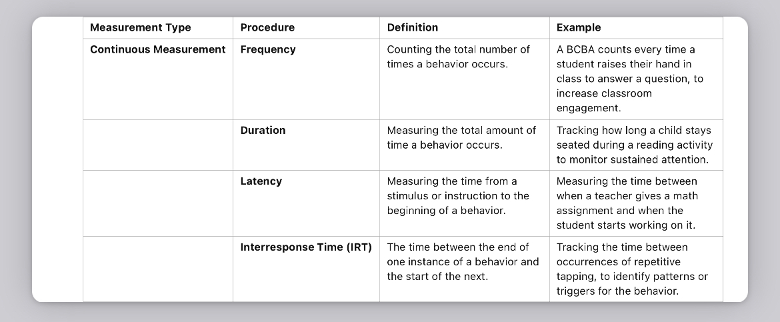
1. Duration:
• Measures the total amount of time a behavior occurs from start to finish.
• Useful for behaviors where the length of occurrence is significant (e.g., tantrums, staying on task).
• Example: Measuring the total time a child spends engaged in a task during a classroom activity.
2. Latency:
• Measures the time between a specific prompt or instruction and the initiation of the behavior.
• Useful for understanding how quickly a behavior starts after a cue, which is relevant for tasks requiring immediate responses.
• Example: Recording how long it takes a student to begin a math problem after being instructed to start.
3. Interresponse Time (IRT):
• Measures the time between the end of one behavior and the beginning of the next instance of the same behavior.
• Useful for understanding the pacing of repetitive behaviors and helps in assessing the rate of behavior.
• Example: Tracking the time between instances of a child calling out in class to gauge whether there is a decrease in frequency.
Methods for Measuring Temporal Dimensions
1. Duration Recording:
• Involves timing each instance of a behavior to capture how long it lasts.
• Typically done with a stopwatch or timer to ensure accuracy.
• Application: A BCBA records the duration of a tantrum from the onset to when the child calms down, helping to evaluate whether interventions decrease tantrum length.
2. Latency Recording:
• Measures the time delay between a prompt and the onset of the behavior.
• Particularly valuable for tracking response times to instructions.
• Application: A BCBA might record how quickly a student raises their hand after the teacher asks a question, providing data on responsiveness.
3. Interresponse Time Recording:
• Measures the time between instances of the same behavior, providing insights into behavioral pacing.
• Particularly helpful for repetitive or frequent behaviors.
• Application: For a client who repeatedly taps their pen, the BCBA measures the interval between taps to see if a relaxation intervention increases the IRT.
Real-World Examples
1. Duration in Classroom Engagement:
• Scenario: A student, Jamie, has difficulty staying on task during independent reading.
• Method: The BCBA tracks how long Jamie remains engaged with his book without interruption.
• Outcome: If the data shows Jamie’s engagement duration increasing, it may indicate that attention-building strategies are effective.
2. Latency in Instructional Compliance:
• Scenario: A teacher reports that her student, Mia, often takes a long time to follow instructions.
• Method: The BCBA records the latency from when Mia is instructed to “line up” to when she actually moves to the line.
• Outcome: By tracking latency, the BCBA can assess the effectiveness of prompts or cues designed to reduce Mia’s response time.
3. Interresponse Time in Self-Stimulatory Behavior:
• Scenario: A client, Tom, frequently engages in hand-flapping.
• Method: The BCBA records the time between instances of hand-flapping.
• Outcome: Interventions aimed at reducing the frequency of this behavior may be successful if the IRT increases, meaning there’s more time between instances of hand-flapping.
Importance in BCBA Practice
1. Duration:
helps BCBAs assess behaviors where the length of engagement or persistence is a concern. For example, measuring the duration of on-task behavior in school or engagement in social interactions provides insight into whether interventions are effective in increasing or decreasing sustained behaviors.
2. Latency
measurement is particularly useful for skills training and compliance. Reducing latency is often a goal in settings requiring prompt responses, such as following instructions in the classroom or initiating social greetings.
3. Interresponse Time
offers critical information for managing behaviors that occur at high frequency, like self-injurious behaviors or repetitive actions. Increasing IRT can help reduce the overall occurrence of these behaviors.
Summary
Mastering the measurement of temporal dimensions—duration, latency, and interresponse time—is fundamental for BCBAs. By accurately capturing these dimensions, practitioners gain valuable insights into the timing, persistence, and spacing of behaviors, enabling them to design more targeted, effective interventions. This data-driven approach supports meaningful progress in clients’ behavior, helping to increase positive behaviors and reduce disruptive or undesired actions.
C.5. Distinguish between continuous and discontinuous measurement procedures.
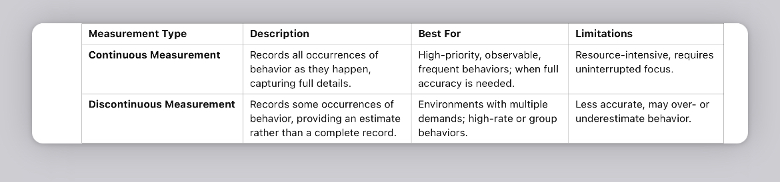
Definition: Continuous measurement involves recording all instances of a target behavior as it occurs. This approach provides a complete picture of behavior over a given period, capturing both frequency and duration.
Examples of Continuous Measurement:
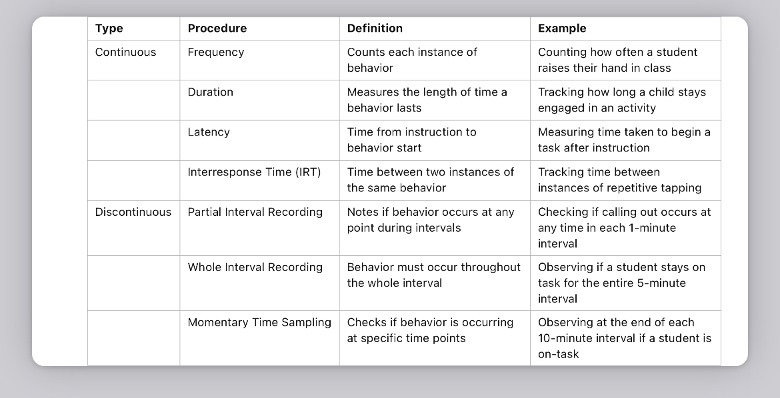
1-Frequency:
Counting each instance a student raises their hand in class.
2- Duration:
Tracking how long a child stays engaged in a reading activity.
3-Latency:
Measuring the time from a given instruction to the start of a behavior, such as how long it takes a student to start a task after being prompted.
4-Interresponse Time (IRT):
Tracking the time between occurrences of repetitive behaviors, like tapping a pencil.
Best Used When:
The behavior is easy to observe and record without interruptions.
The observer has the capacity to focus solely on data collection for the behavior.
Accurate and complete data on every occurrence of behavior is required to guide intervention.
• Strengths:
Provides precise data, giving a comprehensive view of the behavior.
Useful for behaviors that are frequent or high priority for intervention.
Enables the measurement of both the rate and duration of behaviors.
• Limitations:
Can be resource-intensive and requires continuous attention.
Not feasible for tracking behaviors across large groups or long periods.
Discontinuous Measurement Procedures
Definition: Discontinuous measurement involves recording only some occurrences of behavior rather than tracking it continuously. This approach provides an estimate of behavior rather than a full record, making it more practical in situations with limited resources.
Examples of Discontinuous Measurement:
• Partial Interval Recording: Observing if the behavior occurs at any time during a set interval (e.g., a 10-second interval). It provides an estimate of the presence of behavior, often used for behaviors that occur at a high frequency.
• Whole Interval Recording: Observing if the behavior occurs throughout the entire interval (e.g., throughout a 30-second interval). Useful for behaviors where sustained engagement is critical, like staying on task.
• Momentary Time Sampling: Checking if the behavior is occurring at specific moments in time (e.g., at the end of every 5-minute interval). Often used in classroom settings where the observer cannot watch one student continuously.
Best Used When:
The observer has multiple responsibilities and cannot observe the behavior continuously.
A complete record of every behavior instance is not necessary.
The behavior occurs at a high rate, making continuous measurement impractical.
• Strengths:
Requires less time and fewer resources than continuous measurement.
Useful in settings where it is not possible to observe behavior uninterrupted.
Practical for tracking behavior across larger groups or in dynamic environments.
• Limitations:
Provides an estimate rather than a precise count or duration, which may lead to data inaccuracies.
Not as reliable for low-frequency behaviors as it may under- or overestimate actual behavior occurrence.
Real-world scenarios of continuous and discontinuous measurement procedures.
1. Continuous Measurement in a Clinical Setting:
• Scenario: A BCBA is working with a child to reduce instances of physical aggression during one-on-one therapy sessions.
• Method: The BCBA uses frequency recording to track each instance of aggression, allowing for an accurate measure of progress over time.
• Outcome: Continuous data helps the BCBA assess whether interventions are reducing aggression by capturing every occurrence in detail.
2. Discontinuous Measurement in a Classroom
• Scenario: A teacher wants to monitor a student’s on-task behavior but can only check intermittently.
• Method: The BCBA suggests using momentary time sampling, checking at the end of every 10-minute interval to see if the student is engaged in their work.
• Outcome: This approach provides an estimate of the student’s engagement throughout the day without requiring constant observation.
3. Using Partial Interval Recording for High-Rate Behaviors:
• Scenario: A student frequently calls out in class, and the teacher cannot count each instance precisely.
• Method: The BCBA uses partial interval recording, noting whether the calling out behavior occurs at any point during each 1-minute interval.
• Outcome: Partial interval recording captures whether the behavior is frequent, giving the BCBA an estimate of high-rate behavior that helps evaluate intervention success.
4. Whole Interval Recording for Task Persistence:
• Scenario: A BCBA wants to increase a student’s ability to stay focused during independent work.
• Method: The BCBA uses whole interval recording during 5-minute intervals to see if the student stays on task for the entire interval.
• Outcome: This method helps the BCBA track sustained engagement, which is a key goal for the student’s learning objectives.
Importance for BCBA Practice
Mastering the distinction between continuous and discontinuous measurement procedures allows BCBAs to choose the most effective and efficient data collection methods for each client and setting. Continuous measurement provides precise data for high-priority behaviors, while discontinuous measurement offers practical solutions in less controlled environments. By selecting the right approach, BCBAs can gather meaningful data to inform intervention decisions and maximize client outcomes.
Remember: Discontinuous Measurement:
Partial Interval Recording: Observing if the behavior occurs at any time during a set interval. Noting if a student calls out in class at any time during each 1-minute interval, useful for high-rate behaviors.
Whole Interval Recording: Observing if the behavior occurs throughout the entire interval. Monitoring if a student stays on task for the full duration of each 5-minute interval, helpful in assessing sustained attention.
Momentary Time Sampling: Checking at specific moments (e.g., end of an interval) to see if the behavior is occurring. Observing at the end of every 10-minute interval to see if a student is on-task, allowing a teacher to monitor without constant observation.