
A.5. Identify and describe dimensions of applied behavior analysis.
The Seven Dimensions of ABA
1) Applied
• Definition: The intervention targets behaviors that are socially significant and important to the individual and their environment.
• Example: Teaching a child with autism to communicate basic needs, which directly impacts their daily life and interactions.
• Key Takeaway: Applied interventions focus on behaviors that have real-world value and improve the client’s quality of life.
2) Behavioral
• Definition: The behavior targeted for change is observable and measurable, ensuring objective data collection and analysis.
• Example: A teacher tracks how often a student raises their hand in class to increase participation, rather than measuring a vague concept like “engagement.”
• Key Takeaway: Focusing on observable behaviors allows for precise measurement and reliable assessment of progress.
3) Analytic
• Definition: The intervention demonstrates a functional relationship between the behavior and environmental factors, showing that changes in behavior are due to the intervention.
• Example: A behavior analyst increases a child’s use of polite requests by reinforcing each polite request with praise, showing a clear link between reinforcement and behavior change.
• Key Takeaway: Analytic interventions prove that behavior changes are directly related to the intervention, making results more credible and replicable.
4) Technological
• Definition: Procedures are described in detail so that others can replicate them with the same results, ensuring clarity and consistency.
• Example: A behavior plan for increasing task completion in the classroom includes step-by-step instructions for teachers, specifying rewards, prompts, and timing.
• Key Takeaway: Technological clarity allows interventions to be applied consistently across different settings or individuals.
5) Conceptually Systematic
• Definition: Interventions are based on principles of behavior (like reinforcement or punishment), ensuring that ABA practices are grounded in established science.
• Example: A program to reduce disruptive behavior is based on the principle of extinction, where reinforcement is removed for the behavior.
• Key Takeaway: Using established behavioral principles ensures that ABA interventions are theoretically sound and scientifically valid.
6) Effective
• Definition: The intervention produces meaningful, socially significant behavior change that improves the client’s life.
• Example: A reinforcement program successfully helps a teenager increase self-care skills, resulting in greater independence and improved family relationships.
• Key Takeaway: Effectiveness means that ABA interventions lead to real, positive changes for the individual.
7) Generality
• Definition: Behavior changes achieved through the intervention are maintained over time, appear in different settings, and apply across various situations.
• Example: A child learns to use polite language in therapy sessions and continues to use it at home and in school, even after the intervention ends.
• Key Takeaway: Generality ensures that behavior changes are lasting and transferable across different environments and contexts.
Real-World Scenarios for Each Dimension
1. Applied:
• Scenario: A behavior analyst works with a young adult with developmental disabilities to develop job skills that help them gain employment. The intervention targets socially significant behaviors, such as punctuality, following instructions, and task completion, which directly improve the individual’s independence and quality of life.
2. Behavioral:
• Scenario: In a classroom, a behavior analyst helps a teacher measure a student’s on-task behavior by counting the number of minutes the student spends working on assignments. This measurable behavior allows the teacher to track improvements objectively and make data-driven decisions about the student’s progress.
3. Analytic:
• Scenario: A behavior analyst uses a token reinforcement system to increase a child’s willingness to try new foods. They systematically add and remove tokens to show that the child’s willingness to try new foods is directly related to the presence of the reinforcement. This demonstrates a functional relationship between the tokens (reinforcement) and the child’s behavior.
4. Technological:
• Scenario: A behavior plan is designed to help a client reduce aggressive outbursts. The plan includes detailed instructions for implementing a time-out procedure, specifying when and how to apply it, so that all caregivers can apply the intervention consistently and achieve similar results.
5. Conceptually Systematic:
• Scenario: A behavior analyst creates a plan to reduce excessive phone use by using a response-cost procedure (removing points from a reward system every time the phone is used excessively). This approach is based on the principle of punishment and ensures the intervention is grounded in behavioral theory.
6. Effective:
• Scenario: A BCBA implements a social skills program for a teenager with social anxiety. The program leads to significant improvements in the teenager’s ability to interact with peers, which improves their confidence and helps them build friendships. This meaningful change has a positive impact on the teenager’s life.
7. Generality:
• Scenario: A child learns to wash their hands independently through a behavior intervention in the clinic. Over time, the child continues this behavior at home and at school without additional prompts, showing that the skill generalized across settings and was maintained even after the intervention ended.
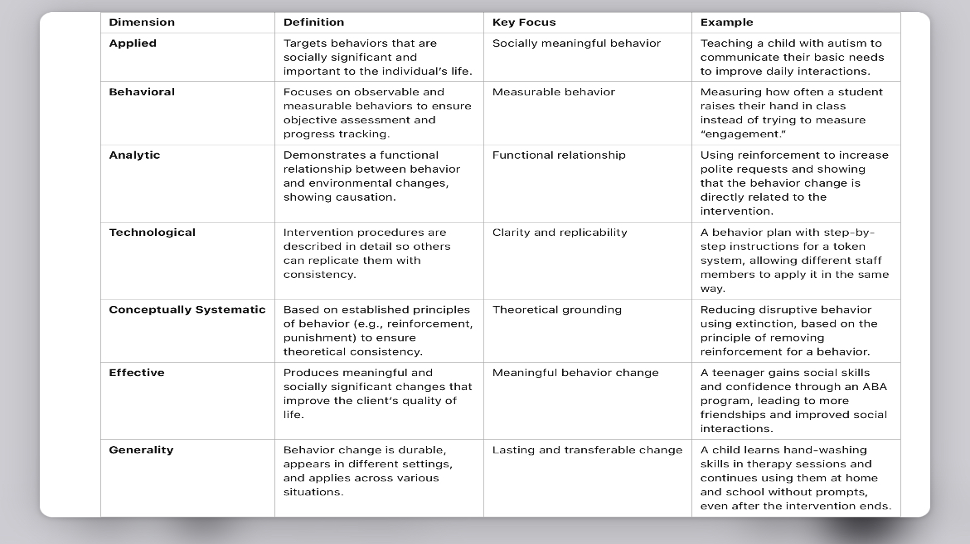
SUMMARY TABLE OF 7 ABA DIMENSIONS
Summary
• The seven dimensions of ABA—Applied, Behavioral, Analytic, Technological, Conceptually Systematic, Effective, and Generality—provide a comprehensive framework for designing, implementing, and evaluating behavior interventions.
• These dimensions ensure that ABA practices are effective, ethical, and impactful, leading to meaningful changes in the lives of individuals and their communities.