C.6. Design and apply discontinuous measurement procedures (e.g., interval recording, time sampling).
Designing and applying discontinuous measurement procedures, such as interval recording and time sampling, are essential skills for Board Certified Behavior Analysts (BCBAs). These methods provide efficient ways to estimate the occurrence of behaviors, especially when continuous observation isn’t feasible.
Understanding Discontinuous Measurement Procedures
Discontinuous measurement involves observing and recording behavior during specific intervals or moments, rather than continuously. This approach offers a representative sample of behavior over time, making it practical in various settings.
Types of Discontinuous Measurement Procedures
• Partial Interval Recording: The observer notes whether the behavior occurred at any point during each interval. This method can overestimate behavior frequency, as it records any occurrence within the interval.
• Whole Interval Recording: The observer records if the behavior occurred throughout the entire interval. This method can underestimate behavior frequency, as it requires the behavior to persist for the full interval.
• Momentary Time Sampling: The observer records whether the behavior is occurring at the exact moment the interval ends. This method provides a snapshot and can either overestimate or underestimate behavior, depending on the interval length.
Designing Discontinuous Measurement Procedures
• Define the Target Behavior: Clearly specify the behavior to ensure consistent observation.
• Select the Appropriate Method: Choose between partial interval, whole interval, or momentary time sampling based on the behavior’s nature and observation goals.
• Determine Interval Length: Decide on interval durations that balance practicality with the need for accurate data.
• Develop Data Recording Tools: Create or select forms or software to facilitate accurate data collection.
Applying Discontinuous Measurement Procedures
• Train Observers: Ensure all individuals collecting data understand the procedures and definitions to maintain consistency.
• Conduct Observations: Implement the chosen method during observation periods, adhering strictly to the defined intervals and recording criteria.
• Analyze Data: Review the collected data to identify patterns, trends, and areas requiring intervention.
Practical Example
Scenario: A BCBA aims to increase a student’s on-task behavior during independent work periods.
• Method: Whole Interval Recording
• Procedure: The observer divides a 30-minute work session into 5-minute intervals. At the end of each interval, they record whether the student was on-task for the entire 5 minutes.
• Outcome: This method helps assess the student’s sustained attention and the effectiveness of interventions designed to improve on-task behavior.
Considerations
• Behavior Frequency: High-frequency behaviors may be better suited for partial interval recording, while low-frequency behaviors might be more accurately captured with momentary time sampling.
• Resource Availability: Choose methods that align with the available time and personnel resources.
• Data Accuracy: Be aware of each method’s potential to overestimate or underestimate behavior, and interpret data accordingly.
Example
Partial Interval Recording
Scenario: A BCBA is working with a student, Alex, who frequently leaves his seat during class. The goal is to reduce this off-task behavior.
• Procedure: Divide the 30-minute class period into 1-minute intervals. At any point during each interval, if Alex leaves his seat, mark that interval as containing the behavior.
• Application: This method is suitable for high-frequency behaviors. It provides an estimate of the behavior’s occurrence and helps in assessing the effectiveness of interventions aimed at reducing seat-leaving.
Whole Interval Recording
Scenario: A BCBA aims to increase a child’s engagement during group activities in a preschool setting.
• Procedure: Observe the child during a 20-minute group activity, divided into 5-minute intervals. Record if the child was engaged in the activity for the entire duration of each interval.
• Application: Whole interval recording is effective for measuring behaviors that should occur continuously. It helps in evaluating whether interventions are successful in promoting sustained engagement.
Momentary Time Sampling
Scenario: In a residential facility, a BCBA needs to monitor residents’ participation in recreational activities without being present throughout.
• Procedure: Set a timer to go off every 10 minutes. At each beep, observe and record whether each resident is participating in the activity at that exact moment.
• Application: This method allows for efficient data collection across multiple individuals and settings, providing a snapshot of behavior at specific moments.
Designing Discontinuous Measurement for Group Settings
Scenario: A BCBA is tasked with assessing the social interactions of a group of children during recess to develop a social skills intervention.
• Procedure: Use momentary time sampling by observing the group at the end of every 5-minute interval over a 30-minute recess. Record the number of children engaged in social interactions at each interval.
• Application: This approach offers an efficient way to gauge overall social engagement levels in a group setting, informing the development of targeted interventions.
Combining Methods for Comprehensive Assessment
Scenario: A BCBA is evaluating a client’s stereotypic behaviors, such as hand-flapping, which occur sporadically throughout the day.
• Procedure: Implement partial interval recording during structured activities to capture any occurrence of hand-flapping. Use momentary time sampling during unstructured times, checking at random moments to see if the behavior is occurring.
• Application: Combining methods provides a more comprehensive understanding of the behavior across different contexts, aiding in the development of effective intervention strategies
Considerations for Practitioners:
• Behavior Characteristics: Choose a measurement method that aligns with the frequency and duration of the target behavior.
• Resource Availability: Select procedures that are practical given the available time and personnel.
• Data Interpretation: Be aware of each method’s potential biases. For instance, partial interval recording may overestimate behavior frequency, while whole interval recording may underestimate it.
By thoughtfully selecting and applying discontinuous measurement procedures, BCBAs can effectively monitor behaviors and make informed decisions to guide interventions.
C.7. Measure Efficiency (e.g., Trials to Criterion, Cost-Benefit Analysis, Training Duration)
Measuring efficiency is a critical component for BCBAs when implementing and evaluating behavioral interventions. It ensures that interventions are not only effective but also practical and resource-efficient. Efficiency measures help BCBAs make data-driven decisions that maximize the impact of interventions while minimizing time, cost, and effort. Here are key methods for measuring efficiency:
Trials to Criterion
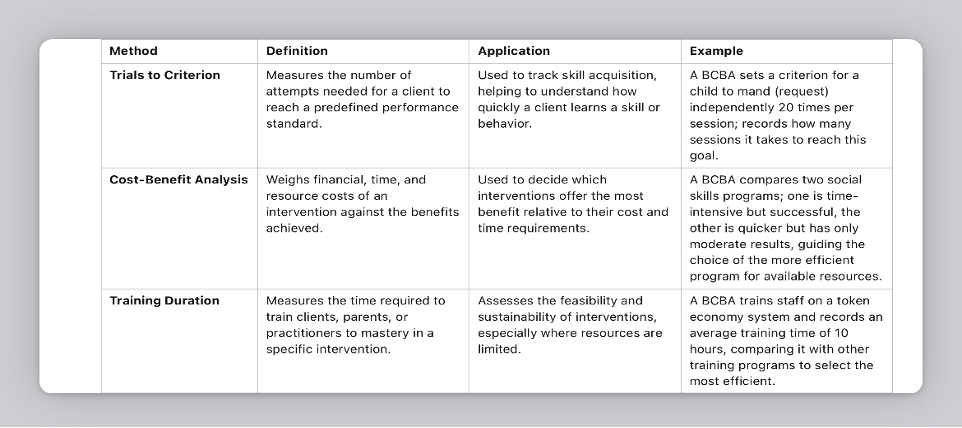
Definition: Trials to criterion is a measure of how many attempts (or trials) a client needs to reach a predefined performance standard. This method is useful in skills acquisition programs, where a specific behavior or skill needs to be demonstrated reliably.
Application:
• BCBAs can set a criterion for success, such as “client will correctly identify colors with 90% accuracy over three consecutive sessions.”
• Tracking the number of trials to reach this criterion can reveal how quickly a client is mastering the skill, providing insight into the intervention’s effectiveness and the client’s learning rate.
Example:
• A BCBA working with a child on manding (requesting) behavior sets a criterion of “20 independent requests per session.” If the child achieves this criterion in five sessions, the BCBA can document this as the trials to criterion and compare it with other skills or clients for a measure of efficiency.
Cost-Benefit Analysis
Definition: Cost-benefit analysis involves weighing the financial, time, and resource costs of an intervention against its benefits. This approach helps BCBAs choose interventions that offer the most substantial positive outcomes relative to their cost.
Application:
• BCBAs can conduct a cost-benefit analysis when considering the adoption of new technology, training programs, or intervention tools.
• It involves calculating direct costs (e.g., materials, staff time) and comparing these with the potential benefits, such as reduced maladaptive behaviors or increased skill acquisition.
Example:
• A BCBA may assess two potential social skills programs for a group of clients. Program A requires more hours of staff time but has demonstrated long-term success, while Program B is less time-intensive but has only shown moderate results. A cost-benefit analysis helps the BCBA decide which program is more efficient for reaching the desired outcomes with available resources.
Training Duration
Definition: Training duration measures the time taken to train clients, parents, or other practitioners to mastery in a specific skill or intervention. This is crucial when considering the sustainability and feasibility of an intervention, especially in settings where resources and time are limited.
Application:
• BCBAs can use training duration to monitor and evaluate how quickly staff or clients acquire necessary skills and how sustainable the intervention is in practice.
• By comparing training durations across different interventions, BCBAs can identify which methods are more efficient and implement those that require less time without sacrificing quality.
Example:
• A BCBA designs a training program to teach staff members how to implement a token economy system. If the average training duration for mastery is 10 hours, this data can be compared with other training programs to determine which ones are most efficient in preparing staff.
Considerations for Practitioners
1. Balance Efficiency and Effectiveness: While efficiency is essential, it should not compromise the effectiveness of the intervention. BCBAs should ensure that an intervention meets the desired outcomes even as they work to reduce costs, time, and resource use.
2. Individualize Measures: Different clients and settings may require different efficiency measures. Tailor these methods to fit the specific needs of each intervention.
3. Data-Driven Decision Making: Use efficiency data to guide intervention adjustments. If a particular skill acquisition program takes significantly longer than anticipated, it may need refinement to improve efficiency.
Summary
Measuring efficiency with tools like trials to criterion, cost-benefit analysis, and training duration allows BCBAs to provide high-quality, effective interventions that are sustainable in the long run. These methods not only support better resource management but also enhance client outcomes by optimizing intervention delivery.
Here are some real-world scenarios that illustrate how BCBA practitioners can apply different efficiency measurement methods:
1. Trials to Criterion for Communication Skills
• Scenario: A BCBA is working with a client, Ben, who has difficulty initiating conversations. The goal is for Ben to independently start a conversation with a peer at least three times per session.
• Procedure: The BCBA tracks the number of sessions it takes for Ben to meet this criterion. Each session, they record whether Ben initiated conversation independently and how many prompts were needed.
• Application: Tracking the trials to criterion helps the BCBA measure how quickly Ben achieves independence in social interactions, allowing the BCBA to adjust the intervention if progress is slower than expected.
2. Cost-Benefit Analysis for Behavior Reduction Plans
• Scenario: A BCBA is designing a plan to reduce aggressive behaviors in a residential treatment facility. They have two options: one intervention requires intensive 1:1 staffing, while the other uses less intensive group reinforcement strategies.
• Procedure: The BCBA analyzes the costs associated with each approach (staff time, resources) against the anticipated reduction in aggressive incidents.
• Application: After implementing a trial period for both interventions, the BCBA compares the outcomes and resources used. This cost-benefit analysis helps in selecting the most effective intervention that aligns with budget constraints without sacrificing efficacy.
3. Training Duration for Parent Training on Reinforcement Techniques
• Scenario: A BCBA is tasked with training parents of a child with autism on using reinforcement strategies at home. The parents’ goal is to apply reinforcement correctly and consistently to increase desired behaviors in the child.
• Procedure: The BCBA tracks the amount of time it takes for the parents to master reinforcement techniques, including initial training and follow-up sessions.
• Application: By recording the time invested, the BCBA can evaluate the effectiveness of the training approach and determine if shorter, more focused sessions might improve the speed at which parents gain mastery.
4. Trials to Criterion for Job Skills in a Vocational Setting
• Scenario: A BCBA is teaching a young adult, Sarah, to complete a multi-step job skill, such as stocking shelves. The goal is for Sarah to complete the task independently within 5 trials.
• Procedure: The BCBA measures the number of attempts it takes for Sarah to complete the task correctly without prompts.
• Application: If Sarah meets the criterion within the set trials, the BCBA can conclude that the teaching method is effective. If not, adjustments can be made, such as breaking down the task further or changing reinforcement strategies.
5. Cost-Benefit Analysis for Social Skills Programs
• Scenario: A BCBA has two social skills group interventions to choose from for children with ASD. One program includes weekly in-person sessions with role-playing, while the other involves a mix of in-person and virtual sessions with a focus on peer interactions.
• Procedure: The BCBA evaluates the resources (staff, time, costs) needed for each program and compares this with the success rate in improving peer engagement in past participants.
• Application: By analyzing both costs and benefits, the BCBA selects the program that balances effectiveness with resource use, ensuring sustainability in the long term for more clients.
6. Training Duration for Classroom Behavior Management Techniques
• Scenario: A BCBA is training a group of teachers on using behavior-specific praise and differential reinforcement to manage classroom behaviors. The goal is for each teacher to implement the techniques fluently within a set time.
• Procedure: The BCBA records the training hours required for each teacher to achieve mastery, including any additional coaching sessions needed.
• Application: Tracking training duration helps the BCBA identify if the method is efficient or if a different approach might streamline the training, ultimately helping more teachers to gain these skills faster.
Each of these scenarios demonstrates how BCBAs can use efficiency measurement tools to optimize interventions and trainings, ensuring they maximize impact while respecting time and resource constraints.
C.8. Evaluate the validity and reliability of measurement procedures.
For BCBA practitioners, evaluating the validity and reliability of measurement procedures is essential to ensure that data accurately represents the behavior being studied and is consistent across time and observers. Here’s an in-depth look at these concepts and how they are applied in behavior analysis:
Understanding Validity and Reliability
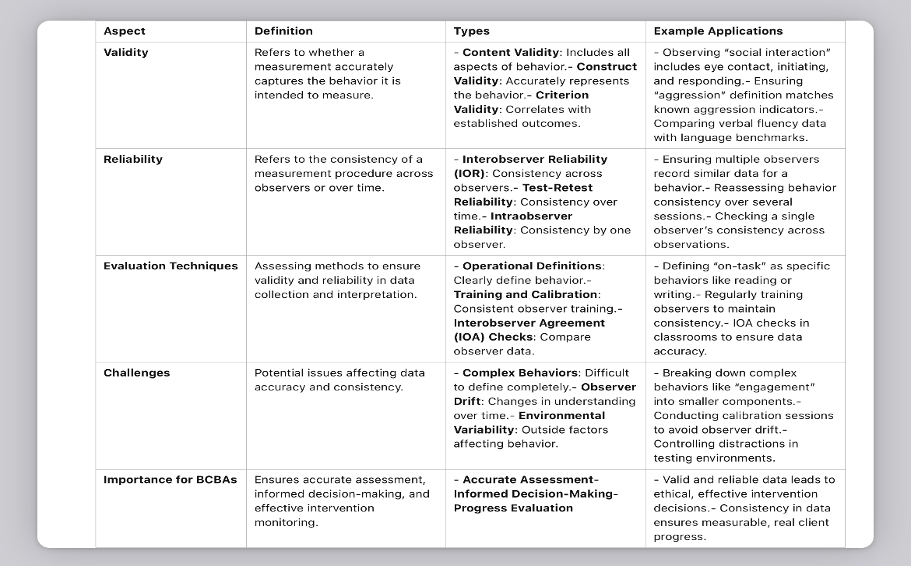
Validity refers to whether a measurement procedure accurately captures the behavior it intends to measure. In other words, it asks: “Are we measuring what we think we’re measuring?” If a measure lacks validity, conclusions drawn from the data may be incorrect or misleading
Reliability refers to the consistency of a measurement procedure. It answers the question: “Would the results be the same if measured by different observers or at different times?” Reliable data is dependable and provides a stable foundation for making decisions.
Both validity and reliability are crucial for BCBAs, as they impact the effectiveness of assessments, interventions, and ultimately, the quality of care provided to clients.
Types of Validity and Reliability
Types of Validity:
• Content Validity: Ensures the measure includes all relevant aspects of the behavior. For example, if measuring social interaction, the measure should account for various aspects like initiating, maintaining, and responding to social interactions.
• Construct Validity: Confirms that the measure accurately represents the concept of interest. For instance, if measuring “aggression,” the operational definition should align with recognized signs of aggression and not mistakenly include other behaviors, such as anxiety-related actions. • Criterion Validity: Ensures that the measurement correlates well with a recognized standard or outcome. For example, a measure of verbal fluency should align with established language development benchmarks.
Types of Reliability:
• Interobserver Reliability (IOR): Confirms that two or more observers achieve similar results when measuring the same behavior under the same conditions. IOR helps to ensure the data’s accuracy and consistency across observers.
• Test-Retest Reliability: Ensures that measurements are consistent over time when the same procedure is applied to the same behavior in similar conditions. This is essential when monitoring long-term behavior patterns.
• Intraobserver Reliability: Ensures that a single observer is consistent in their measurements across different observations of the same behavior.
Evaluating Validity and Reliability in Practice
1. Assessing Validity
• Define Operational Definitions Carefully: Ensure the behavior’s operational definition is precise, observable, and measurable. This minimizes subjectivity and increases content and construct validity.
• Use Multiple Measures: Sometimes, using more than one measure can improve validity. For example, when assessing “compliance,” you might record both verbal and physical indicators of compliance.
• Gather Stakeholder Feedback: Collaborate with teachers, parents, or other professionals to confirm that the measurement procedure aligns with their observations and experiences. This helps ensure the measure accurately reflects the real-world behavior.
2. Assessing Reliability
• Conduct Interobserver Agreement (IOA) Checks: Regularly compare data between observers to ensure interobserver reliability. High IOA scores (typically 80% or higher) indicate consistent data collection between observers.
• Calibrate and Train Observers: Consistent training and calibration sessions help maintain reliability across different observers. Use clear instructions and practice sessions to improve measurement accuracy.
• Repeat Measurements (Test-Retest): When possible, re-evaluate behaviors to confirm that similar results are achieved over time, strengthening confidence in the reliability of the data.
Real-World Scenarios
Scenario 1: Assessing On-Task Behavior in the Classroom
• A BCBA measures a student’s on-task behavior using momentary time sampling. To ensure validity, they confirm that “on-task behavior” is well-defined and includes any activity aligned with classroom goals, such as reading or writing. For reliability, the BCBA conducts IOA with the classroom aide to confirm consistent measurement across observers.
Scenario 2: Evaluating Aggressive Behavior in a Residential Setting
• A BCBA records aggressive incidents in a residential home. They evaluate content validity by confirming that the operational definition covers all forms of aggression (e.g., hitting, kicking). They assess reliability by comparing data collected by two staff members observing the same individual across different times. If the IOA is low, they retrain observers and refine definitions to improve consistency.
Scenario 3: Monitoring Hand-Washing Skills in a Life Skills Program
• A BCBA measures a client’s hand-washing behavior by tracking completion of each step (e.g., turning on water, using soap). For construct validity, they ensure that the measure focuses on all essential steps of hand-washing. They assess intraobserver reliability by having the same staff member record data over multiple sessions, confirming consistency in their observations.
Challenges in Ensuring Validity and Reliability
• Complex Behaviors: Some behaviors, like social interactions, are inherently complex and may challenge both validity and reliability. Breaking down behaviors into smaller, observable components can help mitigate this issue.
• Observer Drift: Observers may unconsciously alter their understanding of the behavior’s definition over time, affecting reliability. Regular calibration sessions and reviews help address observer drift.
• Environmental Variability: External factors, such as noise levels or the presence of different people, can influence behavior, impacting measurement reliability. Minimizing environmental distractions or controlling for them in the analysis can help reduce this variability.
Importance for BCBA Practice.
Accurate Assessment: Valid and reliable data allow BCBAs to accurately assess client progress, ensuring that interventions are effective and appropriately targeted.
Informed Decision-Making: Consistent and accurate data lead to informed clinical decisions, enhancing the quality of care and supporting ethical practice.
Progress Evaluation: Reliable and valid measurements are essential for evaluating intervention outcomes and for making data-based decisions about program modifications or continuation
By prioritizing the evaluation of validity and reliability, BCBAs can ensure that their measurement procedures truly reflect the behaviors of interest and are consistent over time, leading to more effective and ethical practice.